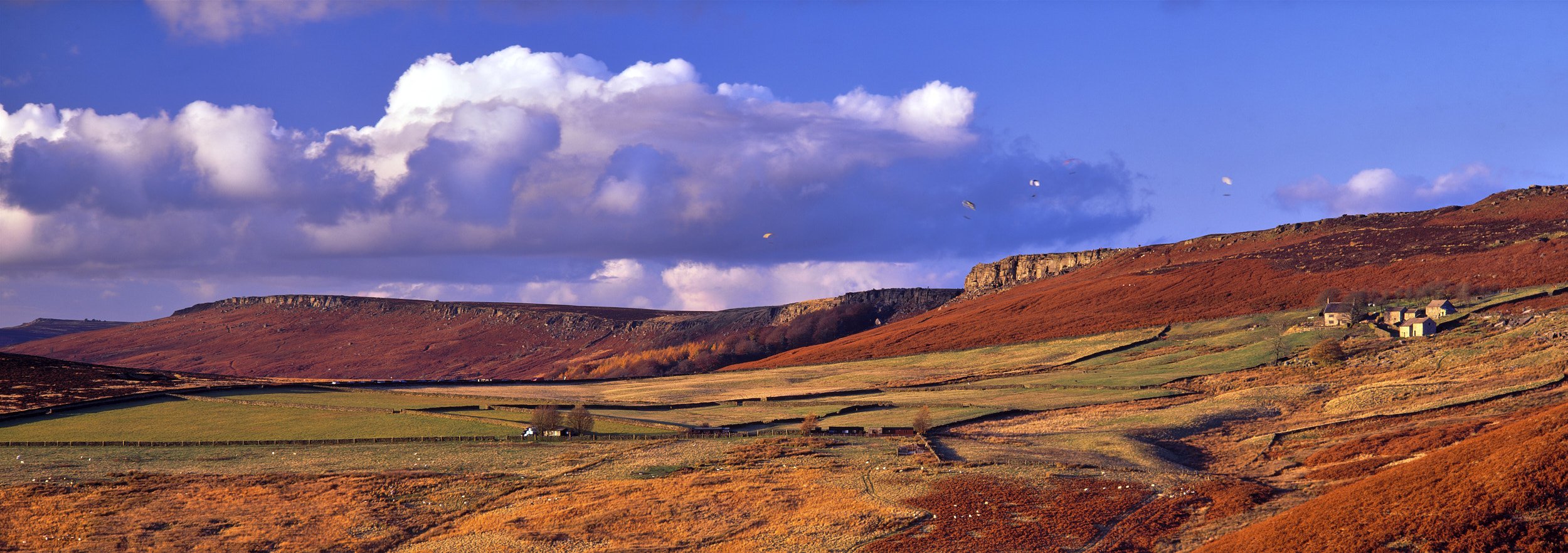
Stanage Edge

The most famous Gritstone edge of them all, justifiably popular, FRIENDLY aspect, but always with quiet spots to be found.
Primarily famous for the sheer multitude of superb trad routes, Stanage is also home to some of the most iconic boulder problems on gritstone - Careless Torque, Crescent Arete, Deliverance etc. The main hub for mid grade trad routes is the well-named Popular End, closest to the road, but with over three miles of near-continuous buttresses and boulders to explore it’s never that hard to find a bit of your own space.
It suffers somewhat from extreme popularity at times, with some polished routes, worn gear placements, receding landings and parking chaos on busy summer weekends. However, topping out that final trad route or boulder problem of the day in the vivid glowing last light of a Stanage evening is a magical rite of passage that never fades no matter how many times you experience it.
Key Facts
Climbing - Natural gritstone, a few old quarried bays - trad, bouldering, 1000s of lines
Aspect - South West, exposed
Popularity - High
Season - All year
Difficulty - Beginner to expert, especially mid grades
Accessibility - 5-20mins walk, rough paths, mainly uphill
Speciality - Unforgettable sunsets
ORDER ART PRINTS of Stanage FOR YOUR WALL
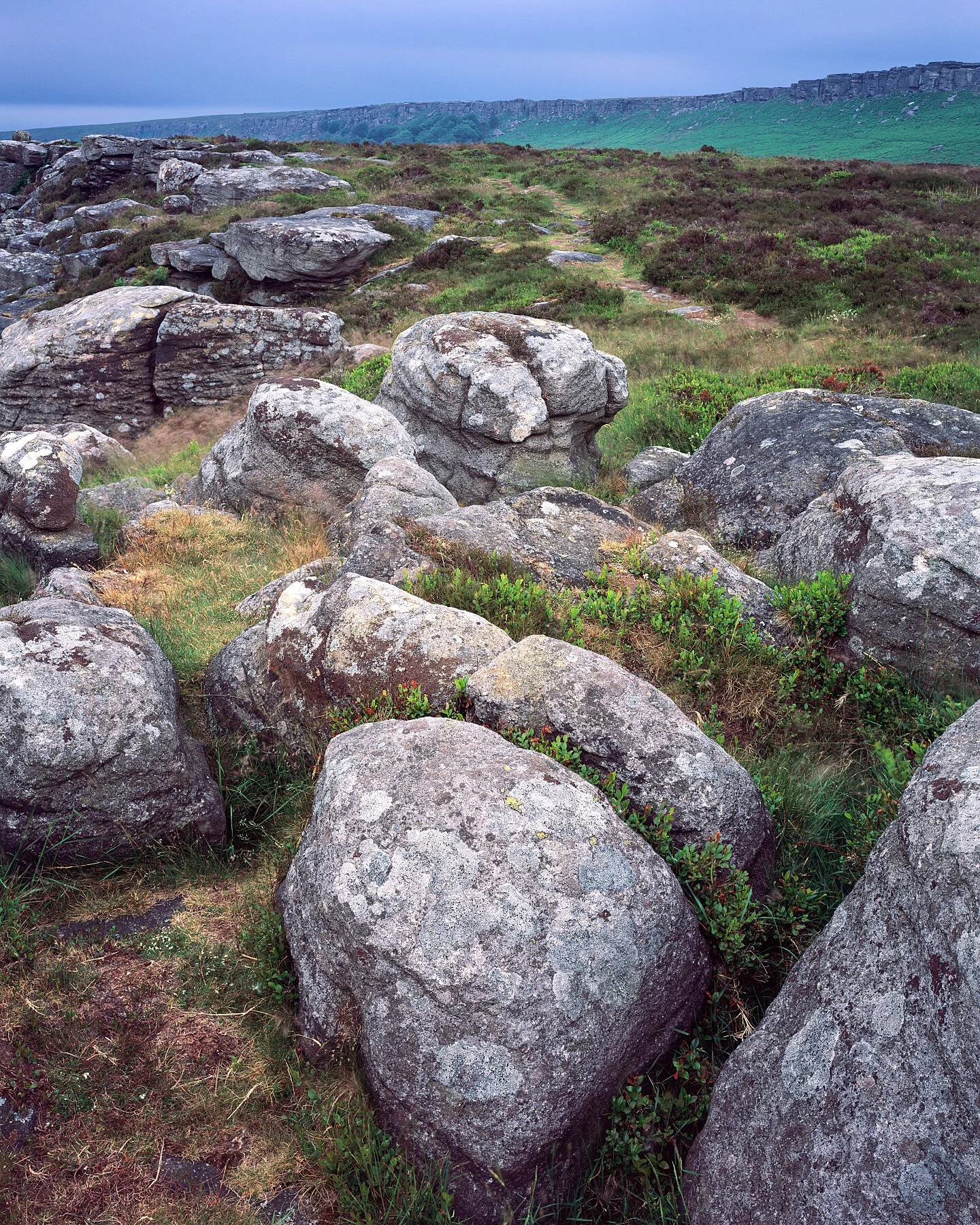
Print made from scanned Fuji Velvia 50 5x4" transparency original.
Compared to Stanage Edge, nearby Carhead Rocks isn't quite as spectacular, not quite as dramatic, but it's not without charm.

Print made from scanned Fuji Velvia 50 5x4" transparency original.
Stanage has long been one of the most popular climbing venues in the UK, and when bathed in the last warm light of a summer sunset it’s easy to see why.

Print made from scanned Fuji 5x4" transparency original.
The iconic Peak District millstones, abandoned beneath Stanage Edge, at a frosty midwinter sunrise.

Print made from scanned Fuji Velvia 50 5x4" transparency original.
The crag top at this part of Stanage presents a wonderful display of grit boulders almost appearing to interlock, pictured during a classic summer gritstone sunset.

Print made from scanned Fuji Velvia 50 5x4" transparency original.
A magical late winter morning atop Stanage Edge, looking out over a cloud inversion in the Hope Valley.

Print made from scanned Fuji Velvia 50 5x4" transparency original.
Water-worn scoops and dishes at the southern end of Stanage Edge, at a midsummer sunset.
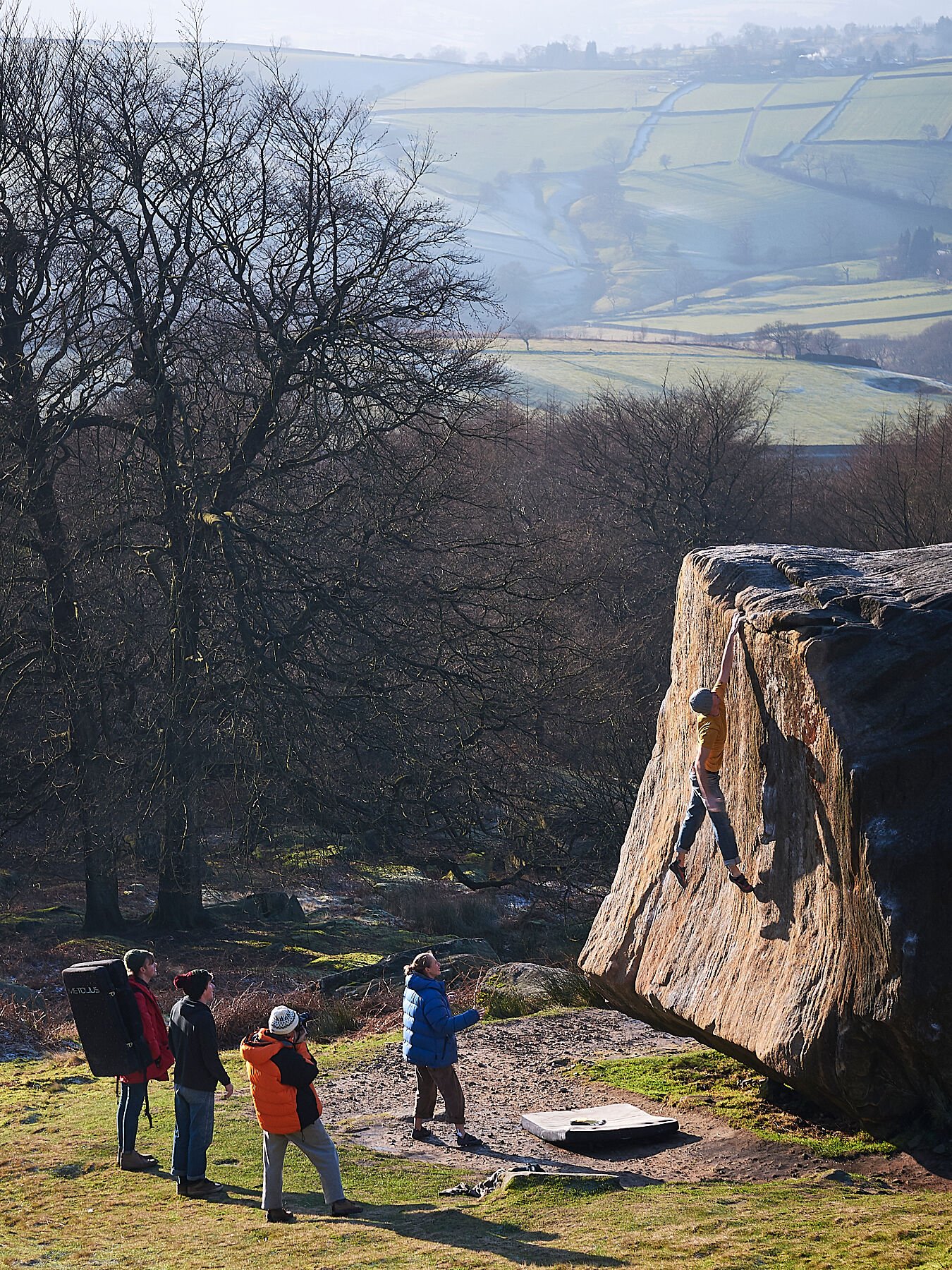
A scene replayed many times over the years - a climber hits the top of the famous problem Deliverance while an inspired crowd looks on.
I was going to talk about surfing the unpredictable ebb and flow of psyche, of ageing, of competing with your younger self, of being steamrollered by the weight of expectation, then being buoyed on by an infinitesimally tiny success. Of the silent guilty resentment when everyone else gets their projects done except you. Of misjudging the conditions, going to the wrong crag, or going to the right crag at the wrong time. Of how there’s definitely a right time for certain things, for you, no matter how fleeting. And how if you can line things up on that day then almost anything is possible. Of how, conversely, if you force it the door slams shut.

When bouldering mats became commonplace in the late 1990s and early 2000s, one of the oft-cited benefits offered up as an excuse for lugging a huge square of foam around (largely to placate the “you’re all going soft, we used to do these problems with just a bar towel stolen from the pub” crowd) was that by using bouldering pads we were protecting the ground from further wear, stopping the grass being battered by repeated falls etc etc. Win win - what selfless legends were were! However, far from being a ‘win’ for erosion, pads clearly just served to enable the whole activity, making it an enjoyable mainstream prospect for all climbers year-round, not just the preserve of fringe nutcases with cast-iron ankles, lowball traverse fans, and cutting edge players needing a training option in the summer - the only time the landings were dry enough to stand on. Hence the massive boom in bouldering participation over the last two decades, with a commensurate strain on the land. Bigger numbers now means at certain places we’re seeing massively accelerated erosion, and it won’t just sort itself out, it’s going to need some legwork from all of us.

It doesn’t hurt that such a full-day immersion in complete bouldering all-you-can-eat gluttony is reminiscent of the fabled “first day in Font” vibes of yore. Arriving in the Forest already dehydrated by 8 hours of driving, fuelled only by coffee, beaucoup pains au chocolate and what scant sleep you managed to scrape whilst lying on the floor of the lounge in a budget ferry whilst being stepped over by various chain-smoking continental lorry drivers, the stage is set for an epic day of climbing. With no concession made to saving any energy or skin, and - with smartphone weather forecasts still a full decade in the future - no way of knowing what the next few days will bring other than a half-remembered forecast, all bridges are burned on the first day. With elbows duly wrecked by locking between the chipped slots on the Cuvier red circuit, the hope is that those bridges can be at least partially reconstructed later that night by judicious use of fingertape, ibuprofen and antihydral. Rinse and repeat for seven consecutive days. Bon chance.

It’s cold, maybe too cold? Turn a cheek to the wind and glance - well, squint - across the moor to the jumble of gritstone boulders silhouetted on the horizon. Gonna be even colder up there. Is the cloud level going to play ball? The hours spent checking and re-checking weather forecasts at least confirms that this is exactly as anticipated. Should be the right conditions for it, on paper at least. That bodes well, perhaps this is the day after all. Could do without leaving empty handed this time, it’s a bit soul destroying. You wonder if you’d have been better off going elsewhere. Cue frantic waving of arms in an effort to pump blood into the fingers, the first of many such episodes.
Print made from scanned Fuji Velvia 50 5x4" transparency original.
First light on Stanage Edge in late winter, with remarkable misty condition dominating in the distance.